Lost Without You
It amazes me how fast time progresses. Another month has gone by since my last post. In that time I tried to catch up on what has been going on photographically on some forums and other websites. I found myself reading some articles written by Joseph Holmes on high end digital and the ins and outs of putting together a medium format digital camera system and dealing with quality control issues as well as the importance of critical focus with such high end imaging equipment. Afterwards I felt like my endeavors in photography were not up to par, lacking, or somehow inferior.
In the past month I also made one trip in search of spring wildflower blooms. I only made two 4×5 photos, and neither was of flowers. I felt like I had missed spring. Then after reading up on high-end medium format digital, I felt like my meager attempts were just that.
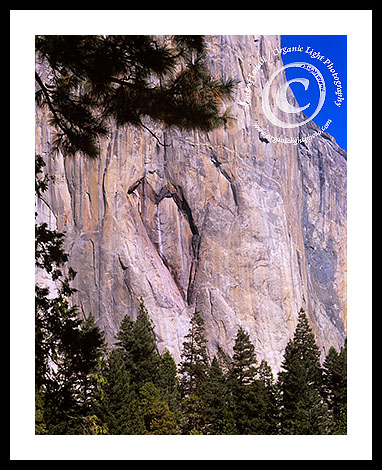
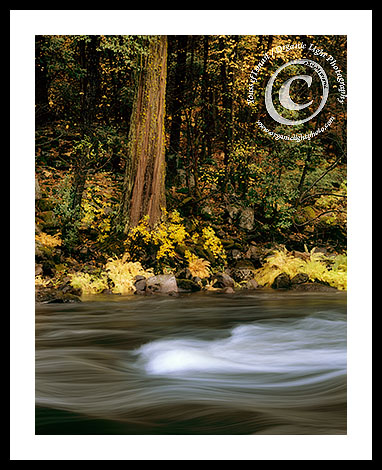
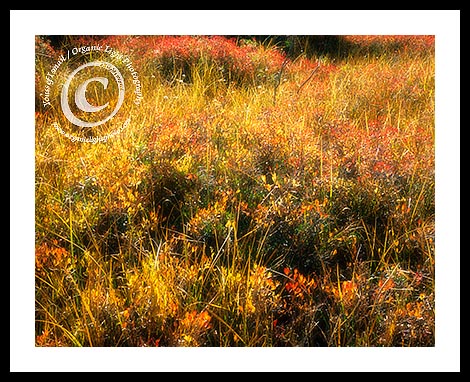
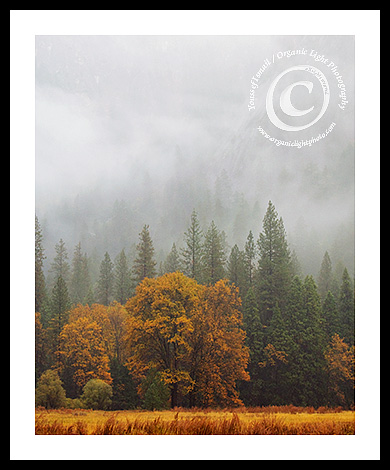
And yet in the past month I sold several photos, all of which were made with the 4×5 except for one, which was made using a 10 MP DSLR camera. Each was exceptional in composition: Emerald Pool, Redwood Glow, Rippled Reflection, Autumn Meadow, Before The Heat, and The Test Of Time. Each photo is moving and each moved the patron who purchased them emotionally.
Then this evening, I went out moon sighting, as I do each month, with a 12 MP Nikon D2x digital camera in hand and a prime 400mm f/5.6 manual focus Nikon lens from the late 1980’s era. No thoughts of inadequacy entered my mind once them imagery began to excite my eyes.
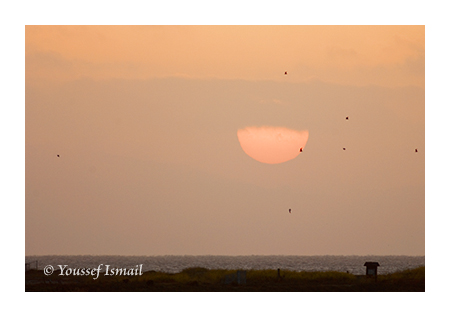
Watching the sun go down across the San Francisco Bay among the haze and clouds and sea birds passing by whipped through the sky by a brisk frigid wind, I recalled reading an article years ago written by Galen Rowell who said (I paraphrase), no matter how often you see the same setting sun, something clicks inside and gets one into the business of making photos and nothing else matters. It was not the most exceptional sunset I had ever witnessed, but one that certainly set the mood for what I was to find.
Once the sun did set, the search in the western sky for that thin crescent moon began. After a while, I wondered if I would see it at all this night as the moon was only 23 hours old past conjunction and would only be 1.5% illuminated – a difficult moon to see at best. After about 20 minutes of not seeing it, my attention was diverted downwards to the exposed mud of the Hayward shoreline estuary on the east side of the San Francisco bay.
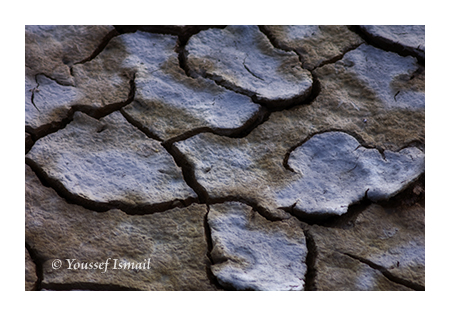
Visually very exciting with the various textures and cracks, the mud became an interesting subject. What made it even more exciting was that the unusual lighting provided by the remaining blue skylight reflected off the drier more bleached areas of the mud giving a surreal feel to the photograph.
Finally, about half an hour after the sun vanished I looked up and saw a small sliver of light appearing in the sky among the clouds. And again, the subtleties of that light came through and with a camera that pales in comparison to what the highest quality digital equipment can produce. Another moving image of the new moon was made.
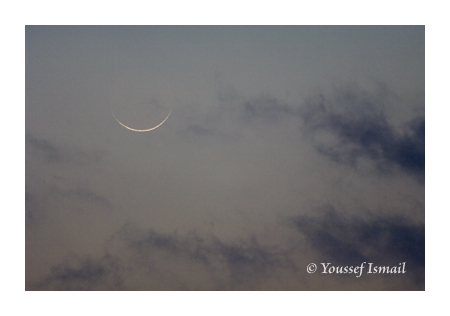
This moon was incredibly fine. I lost it in the sky several times after seeing it. I was very happy to have seen it and record its appearance. But I think what impressed me more was that the camera was able to capture subtleties that my eye could not see as I looked on. In this photo, one can just barely make out the entire outline of the moon. The difference in the luminosity of the sky and the disk of the moon is so small that even in Photoshop the luminosity channel of the L*a*b color space only sees a 1% change, and in some spots not even that, as the cursor is moved across the outline of the moon.
Is this a perfect photo technically? No. It suffers from digital noise. It is not as sharp as it could be, although more than acceptable given that the large telephoto lens I was using was shaking quite a bit in that brisk wind. But it leads me to the question of inadequacy. What makes a camera system inadequate? Again, thinking about how I felt after reading those articles on high-end medium format digital camera systems, I began to think that the equipment I had and used was not up to snuff in producing great photos. But no more than 1 year ago, the Nikon D2x was the Nikon flagship camera, and it is a fine camera. Just a little bit over three years ago, nothing in the digital world could even touch the quality of 4×5 film. And according to Joseph Holmes, assembling a top of the line digital medium format camera system is non-trivial. Along with the high resolutions capable of such large sensors and computer designed digital lenses comes what appears to be real issue of quality control. And as outlined in his articles, in some cases, the results are quite poor given what they are capable of. In addition, ones technique behind such cameras becomes ultra-critcal as Micheal Reichmann wrote about on the Luminous-Lanscape article on the Phase One P65+.
This is all fine as it shows that digital equipment is reaching a pinnacle in capturing true to life images. But I have to ask myself, to what end? Do we need all that resolution? Do we need to concern ourselves, as photographers, about focus being one micron (0.000001 meters or 1/1000th of a millimeter) off? Does it matter for the web where unfortunately most of the digital photos end up? I suppose it comes with the advances in technology that we put this technology to the test, but in the end I think it does not amount to a hill of beans when the final photograph produced has little or no emotional value to the patron.
I am not privy to the sales information of other working fine art photographers, but I do wonder how many prints they sell of any given photograph made with such high-end expensive equipment. I know the argument of price vs. value is what gets thrown around when the price tag of such high end systems are brought up, but can they ever recoup the cost of the equipment?
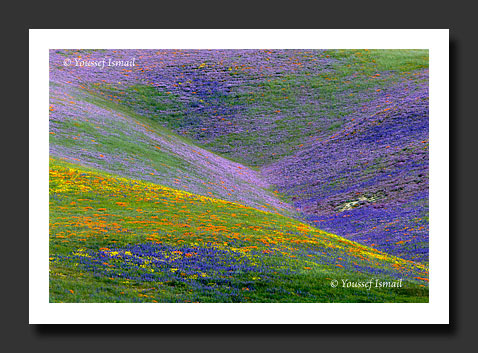
Six years ago during the spring wildflower bloom in Gorman California, I was fortunate enough to have witnessed and photographed that epic bloom. At that time I toted two 35mm cameras, a Nikon F3 and a Nikon F4s, and a barrage of manual focus prime focal length lenses. Digital photography was just making its in-roads and the quality was just about to surpass that of 35mm film. On Easter Sunday morning of 2003 I found myself astounded at that bloom that covered the Gorman Hills. The number of people, photographers and wildflower enthusiasts alike, that had ignored the No Trespassing signs and climbed all over those hills was astounding. I did not however and was very frustrated at not being able to make a photo of just the flowers without having one or more people in the frame. Frustrated, I packed up my gear and proceeded to leave. At the freeway exit there at Gorman, I discovered a dirt road that paralleled Hwy 5 on the west side of the freeway and proceeded down that road. I was now quite a bit away from the hills themselves and had a much wider view. I attached the 400mm telephoto lens to my F4s and started to take intimate photos of the hills. The photo below was one that I came home with.
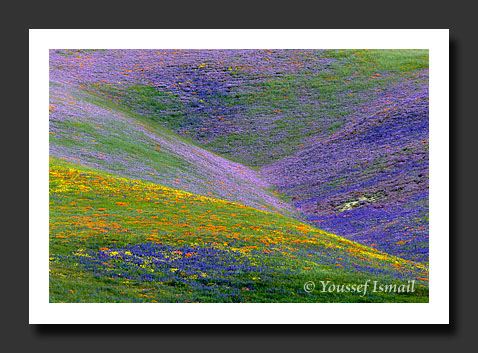
After The Rain
It has been my number one best selling image from the very first time I showed it. It was not unusual for a large 20×30 inch print to be sold each and every week, and sometimes two per week. Now take a look at a 100% crop of the detail found in a 20×30 enlargement.
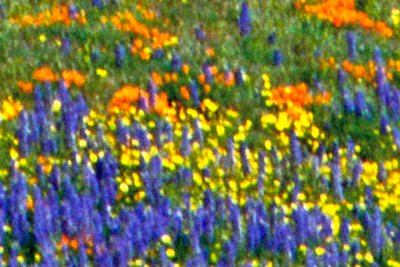
It is absolutely nothing to brag about, in fact it is down right ugly. But it has not stopped patrons from marveling at the bloom depicted, amazed by all the color, and moved to unexplainable tears in some cases. But I can’t count the number of times that patrons have compared the 20×30 print to that of the work of Monet. And while I cannot make a claim that even pales next to Monet’s exceptional work, this photograph has been purchased by nearly 250 different patrons over the past six years. This one photo has literally paid off nearly every piece of photographic equipment that I own.
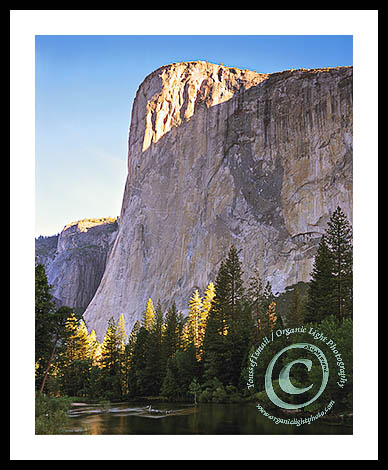
Now if this was not enough, my second best selling photograph, Another Time, again made using 35mm equipment, is poorly focused in the foreground, not by much, but in a 16×24 enlargement it is noticeable to photographers. And yet a framed 16×24 enlargement of that very photograph hangs in the office of the Archbishop William J. Levada in the Vatican in Italy! It was purchased and given to him as a going away gift in 2005 when he moved from San Francisco to the Vatican. He remarked at the time, with tears in his eyes, that it was the most moving photo of Yosemite that he had seen and being a native Californian, Yosemite was his most favorite place and visited there often and that he would be hanging this in his new office. This photo has sold over 120 times since it was made in November of 2001.
Now I am not recounting all of these stories and remarking on the quality of a D2x and old lenses to boast or make anyone believe that my work is anyway exceptional compared to others, in fact I am humbled by the work of many landscape photographers. On the contrary I am trying to point out that photographic equipment will only take a photographer so far. I am not saying that a lowly point and shoot camera can ever take the place of any high-end camera, nor am I saying that a good photo can be made using any camera. But what I want to point out is that as photographers we would not be lost without all of this new cutting edge technology. Yes the technology is remarkable. Yes incredible photos are being made with it. Yes it is stretching the envelope of what is capable. But it has to be in the hands of a capable artist for anything moving to come out of it that will be of any real worth to those who view it. And before you go out and take a second mortgage on your house to finance a top of the line digital medium or large format system, think about the last photo you made and what moved you to make it. Think about the resulting photograph and where it ended up. Was it on paper or did it end up on some web page? Did it move you as an image later the way it moved you when you first saw the scene? Did it move others in the way that it moved you?
Galen Rowell once said “I like to feel that all my best photographs had strong personal visions and that a photograph that doesn’t have a personal vision or doesn’t communicate emotion fails“. That is how I feel about photography as well and it is where I concentrate my energy now, and not on producing lifeless technically perfect images. A camera, no matter how advanced, cannot translate my vision and emotions alone without my artistic ability. And with out that then I would be lost.